

/ Džūlija Rodenkirhena / Interview
Foto Tallinn coming soon. 10 minutes with Lilian Hiob-Küttis
Foto Tallinn 2026 will take place at the Kai Art Center from 18–20 September and will present works by 45 artists from 15 countries, represented by 16 galleries and 15 independently exhibiting artists. A special programme for art collectors will run alongside a 15-event public programme featuring a diverse range of tours, discussions, and conversations.
According to the Artistic Director of Foto Tallinn 2026, Lilian Hiob-Küttis, in an unprecedented age of image overconsumption, stories that resist dominant visual and ideological patterns have become increasingly important. A critical relationship with truth and narrative is gaining significance, as is the question of how a personal point of view shapes our understanding of reality. “Identity, upbringing, community, family stories and personal mythologies, as well as the unease and strangeness of the world we inhabit – all of these find artistic expression at Foto Tallinn in different ways.”
Estonia’s only art fair dedicated to photographic art, Foto Tallinn takes place every two years and will be held for the 12th time this year. More than 90 international guests are expected to attend Foto Tallinn, including art collectors, representatives of museums, exhibition institutions, and art foundations, as well as journalists. Participating gallerists and artists will be on site to introduce the works on display. The jury for Foto Tallinn 2026 comprised Anna Tellgren (Moderna Museet, Stockholm), Jeppe Ugelvig (New York), Margot Samel (New York), Sara Giuliattini (Polycopies, Paris), and Lilian Hiob-Küttis, Artistic Director of Foto Tallinn 2026.
Representing Latvia will be Vika Eksta and Rasa Jansone (ALMA Gallery), Agate Tūna (ASNI), MAREUNROLS and Rūta Kalmuka (ISSP Gallery), Romāns Korovins, and British artist David Penny (Māksla XO). Estonian galleries will present works by Kristīne Krauze-Slucka (Punctum) and Līga Spunde (Kogo Gallery).
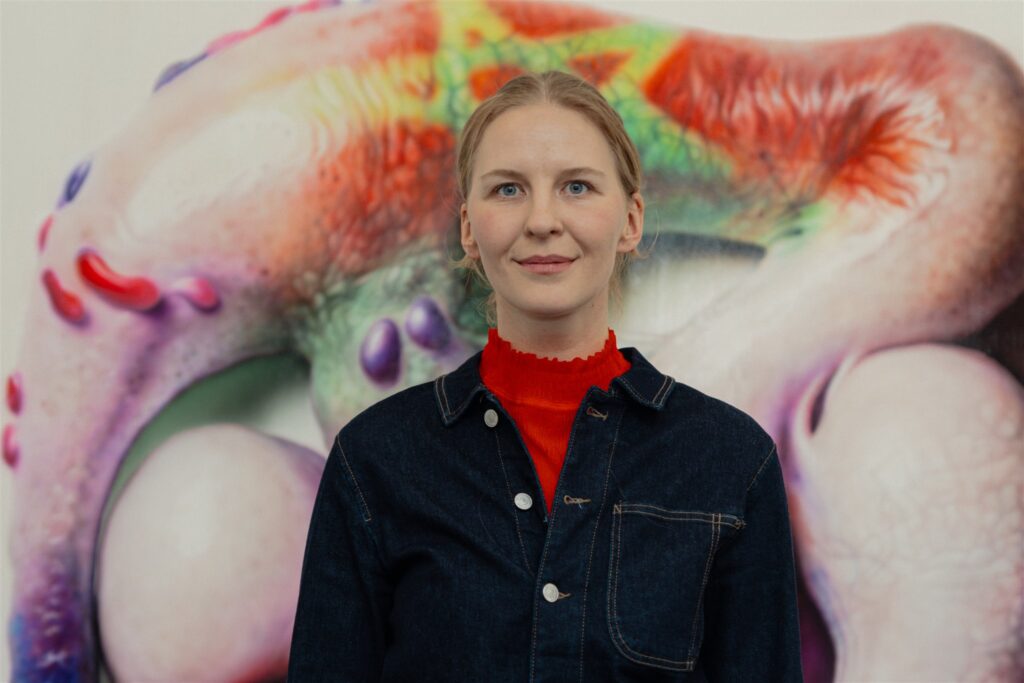
Lilian Hiob-Küttis, Artistic Director of Foto Tallinn, is a curator and art advisor. In Latvia, her work could be seen at ASNI Gallery, where the exhibition Shifting Sand, which she curated, was on view in 2024.
This year’s selection process has been marked by a much higher number of applications than in previous years. What surprised you most about what artists are doing with photography right now?
There is a strong sense of individual authorship. Artists are using photography to construct their own visual and conceptual worlds rather than trying to fit into an established aesthetic.
I also see a very strong return to the specifics of the medium: developing film, printing, sequencing, framing, experimenting with processes and materials. At a time when images can be generated and circulated almost instantly, there is something compelling about artists who are deeply invested in the craft of making an image.
At the same time, many of the works are dealing with very personal material: identity, family histories, memory, origins, and personal mythologies, alongside the more general uncanniness of the world we currently inhabit. The results can be very different formally, but there is a shared sense of artists trying to understand the world on their own terms.
You work across Estonian and international art contexts. What do you think is distinctive about the photographic practices emerging from Estonia and the wider Baltic region?
I think there is a growing confidence in the region around claiming our own histories, identities, and visual languages, rather than trying to fit ourselves into a Western canon. We are here, we have our own histories and cultural references, and artists are increasingly treating these as material rather than something that needs to be translated or legitimised elsewhere.
What I find compelling is precisely this combination of specificity and openness. The Baltic region has a particular historical and cultural complexity, but the strongest artists don’t necessarily illustrate that history. They absorb these histories and rework them into something distinctly personal, contemporary, and formally unexpected. I don’t think we need to position the Baltic scene as an alternative to the West. We are part of the broader contemporary art discourse, and we are contributing to what that discourse becomes.
How would you describe the typical Foto Tallinn visitor, and how has that changed over the years?
I think the Foto Tallinn audience is becoming increasingly diverse, with a strong presence of collectors and people who already have a deep interest in photography, but also artists, designers, teachers, students, and people who simply want to understand what is happening in the field right now.
This year, we have made a particular effort to bring more regional professionals to the fair, as well as international press. We have been working specifically to strengthen Foto Tallinn’s role as a meeting point for professionals from across the region and to create more opportunities for exchange between local, regional, and international audiences.
That is important to me. I don’t think a photography fair should only speak to an established collecting audience. It should also be a place where someone can encounter photography seriously for the first time, while also offering professionals a meaningful context for discovering artists, building connections, and discussing the wider field.
And perhaps the most interesting thing is that the audience is becoming more confident and engaged. People are willing to ask questions, to look beyond what is immediately familiar, and to discover artists they didn’t know before. That curiosity, together with the presence of a strong professional community, is exactly what a fair should encourage.
The program also includes a discussion titled What Does a Museum Do to a Photograph? What motivated this choice, and what will be the main topics of discussion?
Photography has a complicated relationship with the institution. The same image can function very differently as a family photograph, a document, a newspaper image, an artwork in a gallery, or an object in a museum collection. The institutional context changes how we understand its value, authorship, and meaning.
That is what interests me in this discussion, which will take place between Anna Tellgren, curator of photography at Moderna Museet, and Indrek Grigor, Head of the Exhibitions Department at Tartu Art Museum. Together, they will consider what happens to a photograph when it enters a museum: how it is collected, preserved, displayed, and contextualised, and what happens to its material and historical meaning when it moves from one context into another.
These questions also extend to the broader visual culture of the present: commercial photography, family archives, social media, video games, and other forms of image-making that museums have traditionally treated as peripheral or have not yet learned how to preserve. They raise difficult questions about selection, authority, resources, and historical distance.
And also, what does the museum make visible, and what does it leave out? Museums can preserve and legitimise forms of knowledge, but they can also create the impression that photographic history exists only within institutional collections. I think it is essential to remain attentive to the histories that survive elsewhere – in private collections, family albums, personal memories, oral histories, and archives that have not yet entered the museum.
In your opinion, what are the prerequisites for saying that Foto Tallinn has been successful – both in the short term and the long term?
In the short term, the fair needs to work for the people who make it possible: the galleries and artists need to have a good fair, collectors need to find work they genuinely want to live with, and the public needs to feel that there was something worth coming to see. Those things are connected.
But I think the longer-term measure is whether Foto Tallinn can contribute to the development of the photographic field in the region. Whether it can bring artists, galleries, collectors, and institutions into meaningful contact, introduce international audiences to Baltic and Nordic practices, and perhaps change the way photography is understood and collected here.
For me, success means creating something that has a lasting impact. It is about whether, after a few years, we can look back and say that Foto Tallinn helped create a stronger ecosystem around photography in the region.
